


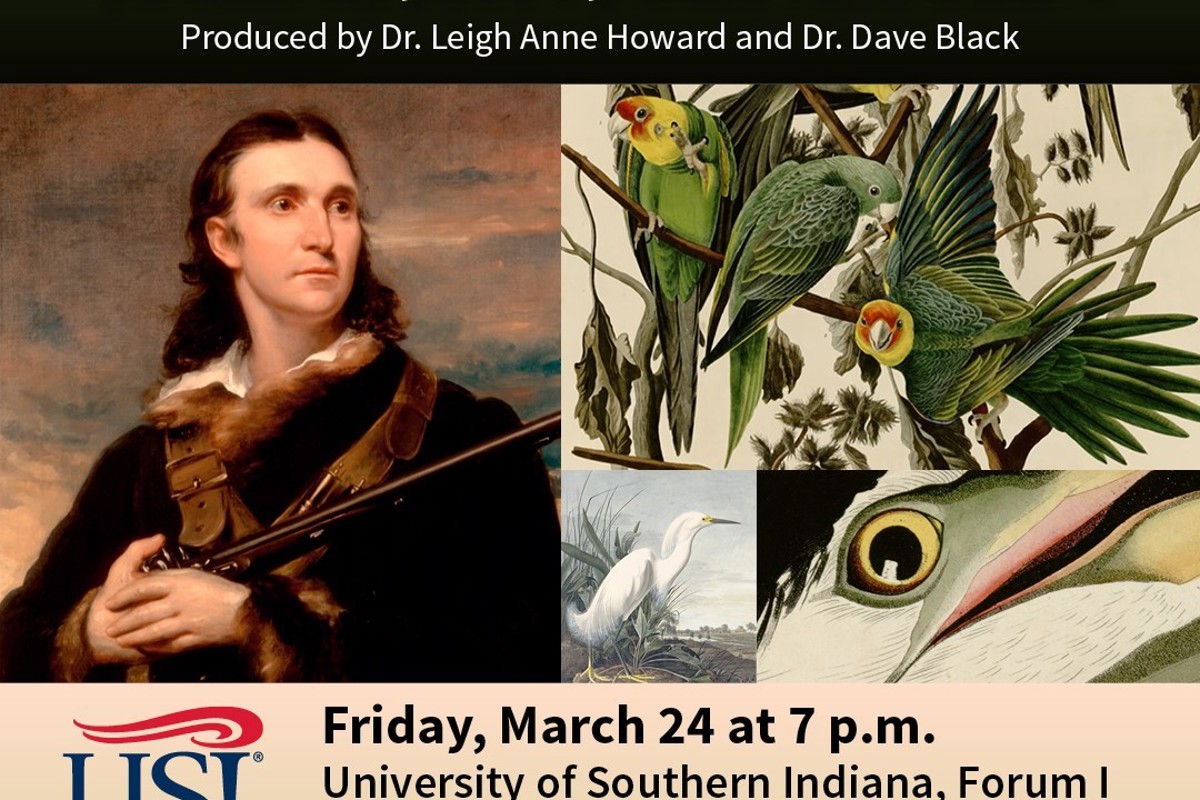
USI Communication and Media faculty members produce Audubon documentary, to be shown at USI
This event, which originally aired on WNIN on February 26 is now being shown on the USI campus at 7 p.m. Friday, March 24 in Forum I, located in the Wright Administration Building. This event is open to the public at no charge.
Two University of Southern Indiana faculty members in the College of Liberal Arts produced a documentary, Art for Science's Sake: Stalking John James Audubon, that will air at 7 p.m. Sunday, February 26 on WNIN. Produced by Dr. Leigh Anne Howard, Communication and Media Department Chair and Professor of Communication Studies, and Dr. David Black, Associate Professor of Radio and Television, the one-hour documentary explores the art and science of 19th century naturalist John James Audubon.
Over the last 10 years, Howard and Black traced Audubon’s footsteps and interviewed a variety of Audubon biographers and experts about the naturalist's contributions to the study of birds through his art. Howard teaches courses in intercultural communication, performance and cultural studies and credits her and Black’s Kentucky roots for their interest in the project.
“We learned about Audubon in grade school and high school, but until we started the project, we did not know how complex and fascinating he really was,” Howard says. “The more we learned and talked to people who shared their own fascination and insights about who he was and what he accomplished, the project took its shape, and we are glad to pass on what we learned.”
Audubon is best known for his mammoth book, The Birds of America, a four-volume work of 435 color plates presenting one of the greatest documentations of birds ever produced. His work initiated a new standard of realism in ornithological depictions. Unlike the naturalists of his time, Audubon painted and published life-size drawings of birds, depicting them in their natural habitats while they engaged in natural behaviors: eating, hunting, feeding their young, flying and socializing. He set out to draw in detail as many North American birds as possible and to record information about their behaviors and physiology in his journals, later published as the Ornithological Biographies.
“It’s been close to 200 years since Audubon was actively creating The Birds of America, and his work still resonates,” adds Black. “He lived and worked in this area and continues, to this day, to be seen as both a remarkable and controversial figure in American history”
Born in Saint-Domingue (now Haiti), Audubon grew up in France before coming to the United States in 1803 to avoid conscription in Napoleon’s army. After working on his father’s farm located near Philadelphia, Audubon moved to Kentucky and started a mercantile business. For a time, he lived and worked in Cincinnati, Louisville and Henderson. He was a controversial figure in his time and remains a dilemma for contemporary society. Some of his works have been questioned for their authenticity, and his ownership of slaves has made his place in history troubling even as his art continues to impress and his contributions to ornithology are appreciated.