


Students are advised throughout their tenure at the University by full-time teacher education faculty who are available during the academic year to discuss goals, career alternatives, and progress. Close collaboration between the student and the advisor contributes markedly to success.
If you are a first-year student, transfer student preparing to be admitted to your major, or a Pott College student seeking academic and career advising, our Student Advising and Resource Center is available to help.
Secondary Education students should contact Mrs. Michelle Herrmann in Teacher Education to be assigned a secondary education advisor.
Upon admission to the Master of Science in Elementary Education (MSE) program, each student will be assigned a full-time faculty advisor within the MSE program. This advisor will support and guide the student throughout their academic journey until graduation.
All doctoral students are initially assigned Dr. Elizabeth Wilkins as their academic advisor at the start of the program. As students advance in their studies, a dissertation chair and committee are formed, who will provide guidance through the dissertation process and support them through to program completion.
Elementary Education Bachelor of Science with approved minor
Elementary Education Bachelor of Arts with approved minor
Elementary Education Bachelor of Science with elementary mathematics minor
Elementary Education Bachelor of Arts with elementary mathematics minor
Elementary Education Bachelor of Science with middle school mathematics minor
Elementary Education Bachelor of Arts with middle school mathematics minor
Elementary Education Bachelor of Science with reading minor
Elementary Education Bachelor of Arts with reading minor
Elementary Education Bachelor of Science with science minor
Elementary Education Bachelor of Arts with science minor
Elementary Education Bachelor of Science with social science minor
Elementary Education Bachelor of Arts with social science minor
Elementary Education Bachelor of Science with special education minor
Elementary Education Bachelor of Arts with special education minor
Early Childhood Education Bachelor of Science with approved minor
Early Childhood Education Bachelor of Arts with approved minor
Early Childhood Education Bachelor of Science with mathematics minor
Early Childhood Education Bachelor of Arts with mathematics minor
Early Childhood Education Bachelor of Science with reading minor
Early Childhood Education Bachelor of Arts with reading minor
Early Childhood Education Bachelor of Science with science minor
Early Childhood Education Bachelor of Arts with science minor
Early Childhood Education Bachelor of Science with social science minor
Early Childhood Education Bachelor of Arts with social science minor
Early Childhood Education Bachelor of Science with special education minor
Early Childhood Education Bachelor of Arts with special education minor
Special Education Bachelor of Science with no minor
Special Education Bachelor of Arts with no minor
Special Education Bachelor of Science with approved minor
Special Education Bachelor of Science with mathematics minor
Special Education Bachelor of Arts with mathematics minor
Special Education Bachelor of Science with reading minor
Special Education Bachelor of Arts with reading minor
Special Education Bachelor of Science with science minor
Special Education Bachelor of Arts with science minor
Special Education Bachelor of Science with social science minor
Special Education Bachelor of Arts with social science minor
Elementary Education/Special Education Double Major (Bachelor of Science)
Elementary Education/Special Education Double Major (Bachelor of Arts)
Elementary Education/Early Childhood Education Double Major (Bachelor of Science)
Elementary Education/Early Childhood Education Double Major (Bachelor of Arts)
Early Childhood Education/Special Education Double Major (Bachelor of Science)
Early Childhood Education/Special Education Double Major (Bachelor of Arts)
The Co-Teaching Model is used by USI clinical interns and cooperating teachers during the clinical internship semester. Co-Teaching is defined as two teachers sharing the planning, organization, delivery, and assessment of instruction, as well as the physical space in the classroom. Cooperating teachers who host a USI clinical intern are expected to be knowledgeable of and use the Co-Teaching Model. USI will provide cooperating teachers with a Co-Teaching Training video. All clinical interns and university supervisors receive Co-Teaching Training prior to the beginning of the clinical internship semester. For more information, contact Ms. Lisa Bartley, Director of Clinical Internships.
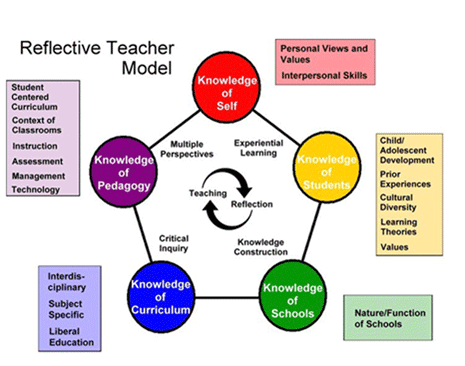
The Reflective Teacher Model is an undergraduate teacher education program based upon a philosophy of active and experiential learning and critical inquiry into underlying issues in education and society from multiple perspectives.
This philosophy emphasizes the development of the preservice teacher as a reflective practitioner who exhibits the following characteristics:
Reflective teachers initiate instruction cognizant of the needs of the students as expressed through their experience. Reflective teachers aim instruction toward actions or convictions that resolve the questions, tensions, and perplexities that initiated the student's process of inquiry.
Reflective teachers recognize that the social process of education is also personal, and that it cannot be coerced from others, but must be chosen by them.
Reflective teachers enhance relationships with students by acknowledging students' capacity as reflective thinkers. Reflective teachers take seriously students' problems, hypotheses, and conclusions.
Reflective teachers know that it takes time for ideas to be developed, delineated, and evaluated. Reflective instruction may take days, weeks, or years to achieve its purpose.
Reflective teachers allow for divergence and technological change. They seek to expand options rather than limit them. They consider alternative methods and points of view, and they are willing to change their mind.
Reflective teachers explore, investigate, and grow. They are suspicious of their own conclusions because they know that they are learners.
Reflective teachers take their own reasoning processes as part of their field of inquiry. They are conscious of their assumptions, logic, choices, priorities, and conclusions.
Reflective teachers ponder how their decisions will affect the lives of the children they teach. They ask not only, "How can I do this better?" but also, "Why do I do this?"
Search the Indiana Department of Education school personnel job bank. Filter results by school, category, type, and start date.